Claim the Spot, Build the Scene: How Crew Rivalries Are Making BMX Stronger
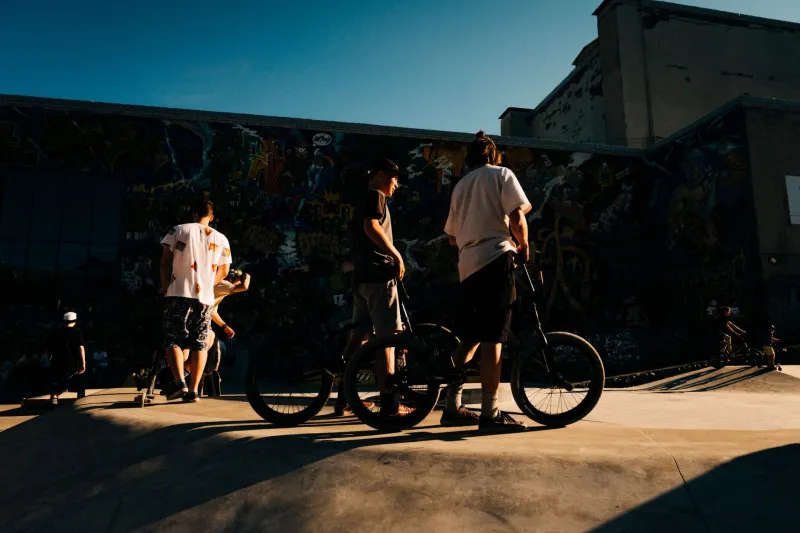
Every serious BMX scene in America has one. That spot — the ledge, the bank, the plaza, the gap — where more than one crew thinks they've got the claim. Maybe your boys found it first. Maybe another crew has been riding it longer than you've been alive on a bike. Maybe nobody knows who "owns" it and that's exactly where the tension lives.
Spot beef gets a bad reputation. From the outside it looks petty — grown men arguing over who gets to ride a public staircase. But spend enough time in local scenes and you'll start to see something more interesting happening underneath all of it. The competition over territory, when it plays out the way it's supposed to, isn't tearing communities apart. In a lot of cities, it's quietly making them stronger.
The Unwritten Law of the Spot
BMX has never had a governing body that settles disputes over who rides where. There's no referee, no deed of ownership, no official ranking system. What there is, in every functioning scene across the country, is an unspoken code that most riders understand without it ever being explained to them.
You show up to a spot somebody else is sessioning, you wait your turn. You don't snake runs. You don't bring a crowd of thirty people to a spot that's already on edge with security. And if another crew has clearly put time into a location — if they've swept it, cleared obstacles, maybe even done a little DIY work to make it rideable — you acknowledge that before you start treating it like your own.
When that code gets violated, that's when real beef starts. And real beef, in BMX, rarely looks like what outsiders imagine. It's not usually fights — it's more like a slow, competitive burn. A silent challenge. You think you can ride this spot? Show me something.
Competition as Fuel
There's a reason some of the most progressive riding in any given city tends to happen at contested spots. When two crews both feel ownership over the same piece of ground, neither one wants to be the crew that showed up and looked mediocre. Pride is a powerful motivator.
You start seeing riders attempt things they'd never try in a casual session. Lines that seemed impossible suddenly get worked out because somebody from the other crew just did something you didn't think was doable there. The bar gets raised, and it gets raised fast.
This dynamic has played out in scenes across the US for decades. In cities like Philadelphia, Chicago, and Los Angeles — places with deep, layered BMX histories — some of the most iconic footage ever filmed came out of sessions where multiple crews were quietly going at it, each trying to outdo the other without anyone explicitly saying that's what was happening. The camera caught the tricks. What it didn't always capture was the competitive energy underneath them.
When Beef Becomes Respect
Here's the part that doesn't get talked about enough: genuine rivalry, when it's handled right, almost always ends in respect.
You spend enough sessions riding the same spot as another crew — even if you showed up on opposite sides of an unspoken dispute — and you start to notice things about each other. You see who's putting in real work. You see who's got creativity, who's got guts, who handles a bail with grace and gets back up without drama. And eventually, without anyone making a formal announcement, the beef dissolves into something that looks a lot like community.
The riders who were eyeing each other from across a parking lot six months ago are now hyping each other's clips, tagging each other in posts, maybe even sessioning together. The spot that was a point of contention became the place where two separate groups built a real connection.
This is not an accident. It's a feature of how BMX culture has always organized itself — through shared ground, shared risk, and the kind of mutual respect that only comes from watching someone else do something hard.
The Role of Spot Ownership in Scene Health
There's a practical side to this too. Spots that have a crew invested in them tend to last longer. When riders feel ownership over a location, they look out for it. They manage the relationship with property owners or surrounding businesses. They self-police the behavior that would get the spot shut down — the stuff that brings security, that draws noise complaints, that ends sessions permanently.
In cities where no crew claims anything, spots get burned fast. Too many people, too much chaos, no accountability. But when a local crew has put their flag in the ground at a location, there's an informal maintenance structure that forms around it. They know the security rotation. They know which neighbors are cool and which ones will call the cops. They know how to make a spot last.
Rivalry over territory, ironically, often creates better stewardship of the spots themselves. Two crews fighting over the same ledge both have a reason to keep that ledge alive.
What This Looks Like in 2025
Social media has complicated the spot beef dynamic in ways that are still playing out. When a crew posts footage from a spot, they're essentially planting a digital flag — and that flag is visible to every rider in the country, not just the local scene. Spots that used to be known only to a tight regional circle now get discovered by riders from across the country after one clip goes viral.
This creates a new layer of tension. Local crews who've invested years in a spot suddenly have to deal with out-of-towners who found it through Instagram and show up with no understanding of the local code. How that tension gets navigated says a lot about the maturity of a scene.
The scenes that handle it best are the ones that lead with welcome over hostility — that show visiting riders the spot's history, explain what's worked to keep it open, and bring them into the culture rather than treating them as invaders. The beef becomes a conversation, and the conversation builds something bigger than any single crew.
The Bottom Line
Spot rivalry is real, it's messy, and it's never going to disappear from BMX. But framing it purely as a negative misses what's actually happening on the ground in scenes across this country. Competition over territory drives progression. Pride pushes riders to their limits. And when the dust settles, the crews that went through that friction together are usually the ones with the deepest bonds.
The concrete doesn't care who claims it. But the culture that grows up around it? That's built by the beef, the sessions, and the respect that comes after.