Ride or Die: Why Your BMX Crew Is Worth More Than Any Follow Count
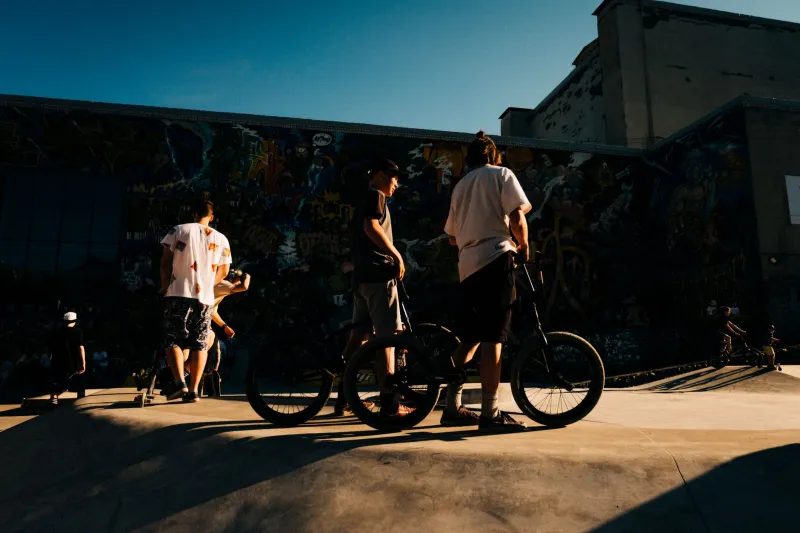
Scroll through Instagram on any given Tuesday and you'll find a thousand BMX accounts—highlight reels, slow-motion clips, product drops, and sponsored shoutouts. What you won't find is what it actually feels like to land your first barspin in front of the four dudes who've been watching you eat concrete for the past six months. That moment doesn't live in a caption. It lives in the parking lot of some school you've been sessioning since middle school, surrounded by people who actually know your riding.
That's the crew. And right now, in a culture increasingly obsessed with followers and reach, the crew might be the most important thing in BMX that nobody's marketing to you.
How Crews Actually Form (Hint: It's Not a DM Request)
Ask anyone who's been riding for more than a decade how their crew came together, and the story is almost always the same: proximity, repetition, and time. You start showing up to the same spot. You recognize each other. You start spotting tricks. You argue about lines. You share water. You come back the next weekend.
That's it. No group chat invite required—at least not at first.
Jordan Reeves, who's been riding with the same core group in Columbus, Ohio for going on fourteen years, put it plainly: "We didn't form a crew. We just kept showing up and eventually realized we were already one." Jordan's group has cycled through members over the years—guys who moved away, guys who got hurt and never came back—but the foundation stayed intact. "The ones who stuck around are the ones who were really there for the riding, not the scene."
That distinction matters more than it used to. When social media started bleeding into BMX culture in a serious way around the early 2010s, it introduced a new kind of rider—one chasing visibility as much as progression. Crews started to feel the friction.
The Transactional Follower vs. The Actual Homie
There's a real difference between someone who follows your riding and someone who rides with you. The follower double-taps and keeps scrolling. The homie shows up at 8 a.m. on a Saturday when it's 45 degrees because you texted the night before saying you were close to locking in a new combo.
In Phoenix, a crew called the Desert Dogs—a loose collective of about eight riders who've been grinding the same street spots and concrete parks for over a decade—have watched plenty of people come through looking for content rather than community. "You can tell in the first session," says longtime member Marcus Ybarra. "Some guys are scoping angles for their phone before they even throw a leg over their bike. That's fine, we're not hating. But those dudes usually don't last."
The Desert Dogs operate on what Marcus calls "earned entry." Nobody gets formally invited. You ride with them, you respect the spot, you don't snake runs, you hype up the crew when someone's trying something hard—and eventually you're just part of it. "We've never had a tryout," he laughs. "But everyone who's been around long enough knows exactly how it works."
That informal code is something you'll hear echoed in crews from Portland to Atlanta. It's not written down anywhere. But it's real.
Mentorship the Algorithm Can't Replicate
One of the most underrated things a crew does is teach. Not through tutorial videos or comment section advice—but through proximity. When you're riding with someone who's three skill levels ahead of you, you absorb things you can't even articulate. The way they read a transition. How they manage speed before a gap. When they decide to walk away from a trick instead of keep going and risk a bad bail.
That's mentorship. And it's something no YouTube rabbit hole can fully deliver.
In Richmond, Virginia, a crew that's been rolling together since the early 2000s has made mentoring new riders a deliberate part of their identity. "We had older dudes who put time into us when we were coming up," says founding member Dez Holloway. "That's just how it gets passed down. You don't let the knowledge die with your generation."
Dez's crew has watched multiple younger riders come through over the years—some of whom have gone on to compete regionally, others who just ride for the love of it. Either way, the throughline is the same: someone took time to invest in them when they were raw and green and didn't know how to take a fall properly.
"You can watch a barspin tutorial fifty times," Dez says. "But nothing beats having someone stand next to you and tell you exactly what your hands are doing wrong."
Accountability Is a Love Language in BMX
Crews push you. Not in the corny motivational-poster way—in the way where someone calls you out for going soft on a trick you've already landed clean three times. Or in the way where they tell you to take a break before you hurt yourself because they can see your form breaking down before you can.
That kind of accountability is rare. And it's built on trust that takes years to develop.
In Chicago, a street-focused crew called the Midwest Mob has been known for their brutally honest sessions. "We don't coddle each other," says rider and crew veteran Trey Simmons. "If your foot position is wrong, we're gonna tell you. If you're scared, we're gonna tell you that too—and then we're gonna help you figure out how to not be scared."
Trey is quick to add that it comes from a place of love. "Nobody in our crew is trying to embarrass you. But we're also not gonna blow smoke just to make you feel good. That doesn't help you get better. It just makes you comfortable being stuck."
That's the kind of feedback that builds riders. And it's fundamentally different from the validation loop of social media, where every clip gets fire emojis regardless of whether the trick was actually clean.
Showing Up Is the Whole Thing
At the end of the day, what makes a crew last isn't talent or aesthetics or how hard anyone goes on a given day. It's consistency. It's the rider who's there even when the weather's trash. It's the person who brings an extra tube because they know somebody's gonna flat. It's the group chat that stays active between sessions because everyone genuinely wants to know how the others are doing.
In a social media era that rewards performance over presence, that kind of quiet loyalty is almost countercultural. And maybe that's why the riders who have it tend to hold onto it so fiercely.
Jordan from Columbus said something near the end of our conversation that stuck with us: "I've had a lot of followers come and go. But I've had the same five dudes at my back for over a decade. I know which one means more."
Yeah. We do too.
Ride hard. Rep your crew. That's the culture.